Weldo
An experiential safety-training system that helps welders feel the consequences of skipping PPE, and the relief of making a safer choice.
- PROJECT
- University live brief with 3M
- TEAM
- Team of six
- MY ROLE
- Prototyping lead and icon design
- YEAR
- 2025
THE PROBLEM
Welders know the risks of skipping PPE. They skip it anyway: it's uncomfortable, they're rushed, and nobody around them wears it.
WHAT WE BUILT
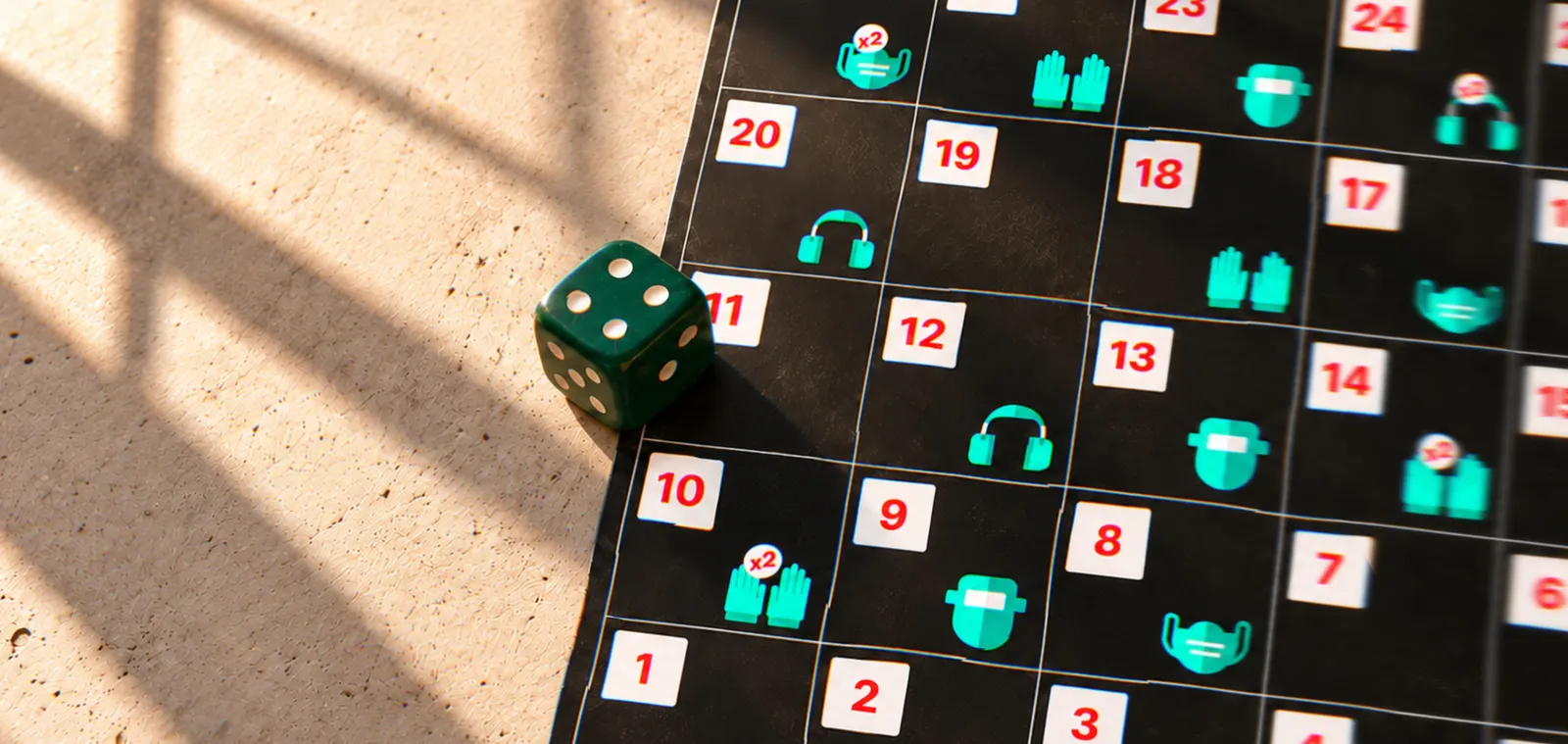
A life-sized, cooperative game. Players start with props that simulate vision, hearing, lung and skin damage, and take them off by landing on PPE squares. The squares use icons instead of words, so the board does not depend on a shared language. We also made an awareness film in several languages.
THE CONSTRAINTS
The brief asked for a modular tool with digital and tangible parts that works across languages and site conditions. We built the props and the full-size board ourselves, from everyday materials.
WHAT HAPPENED
Ten welders played for about ten minutes. 7 of 10 said the props mimicked symptoms they'd begun to feel. The project was selected by 3M for a presentation to stakeholders from across the MENA region.
The brief
A live brief from 3M
Create an interactive, modular demo tool that uses digital and tangible elements to show welders the long-term health risks and the protective benefits of PPE, across languages and site conditions.
Research
We started with the welders
We interviewed 15 welders at two factories, and reviewed 3M's existing awareness material. It listed the major health consequences of skipping PPE, but it was text-heavy and dull to read.
12 of 15
struggled with arc eye while learning
10 of 15
are aged 30–40
5 of 15
speak Hindi as their first language
8 of 15
currently have eyesight problems
What we heard
Six things came up again and again
We clustered our notes, built an empathy map, and narrowed to a smaller set of needs and emotions.
Training is rushed
It's mostly peer-led and informal.
PPE is uncomfortable
Heat, fogging and sweat lead to avoidance.
Learning is painful early on
Severe eye irritation, burning and difficulty sleeping.
Injuries are normalised
"You get used to it."
Language is a barrier
Hindi, Malayalam, Tamil, Urdu, Arabic and Bihari.
Attitudes differ
Senior welders felt protected by their years of experience and played down the risk. Others put speed and income first.
The problem
Welders know the risks.
Three things stop them acting on it.
Comfort
PPE feels hot, heavy or restrictive.
Time pressure
Rushed jobs mean skipped gear.
Habit
Everyone around them doesn't wear it, so they get used to it.
That led us to frame the problem around habits and social norms. The formal safety material and daily practice on site were far apart.
What the research says
The damage builds slowly
The WHO and ILO classify welding as a high-risk job.
Chronic vision damage
Including cataracts.
Permanent hearing loss
Noise-induced, and it does not come back.
COPD
Chronic obstructive pulmonary disease, from years of fumes.
Chronic dermatitis
With a higher risk of skin cancer.
Ideas
From idea dump to one direction
To shift attitudes toward PPE, welders needed to engage with their environment instead of being lectured.
- 01
Idea dump
Every idea on a sticky note.
- 02
Roses, Buds, Thorns
What works, what could, what does not.
- 03
Crazy 8
Eight quick sketches of the strongest ideas.
- 04
One direction
Emotional, to work on attitude. Game, to make the learning interactive.
Many ideas leaned on AR and VR or on graphic posters. We set those aside because they wouldn't change behaviour the way play could.
For the film we chose the family story over a single welder's story, because emotional messages tend to persuade more in cultures where decisions are tied to family.
Why a game
Adults learn by doing
Adults are self-directed learners. They explore and experiment, and they only accept knowledge that feels practical and necessary.
14%
more skill-based knowledge than the comparison group
11%
more factual knowledge than the comparison group
9%
better retention of the material
Reading the numbers
From a meta-analysis of 65 studies of computer-based simulation games, so we treated the numbers as a hint for a physical, life-sized game.
Sources
- Sitzmann, 2011A meta-analytic examination of the instructional effectiveness of computer-based simulation games.Personnel Psychology, 64(2), pp. 489–528.
- Kolb, 1984Experiential Learning: Experience as the Source of Learning and Development.Englewood Cliffs, NJ: Prentice Hall.
- Knowles, 1980The Modern Practice of Adult Education: From Pedagogy to Andragogy.Revised edn. Chicago: Follett.
The solution
Weldo
A cooperative, life-sized game that lets welders feel the discomfort of skipping PPE, and the relief of using it.
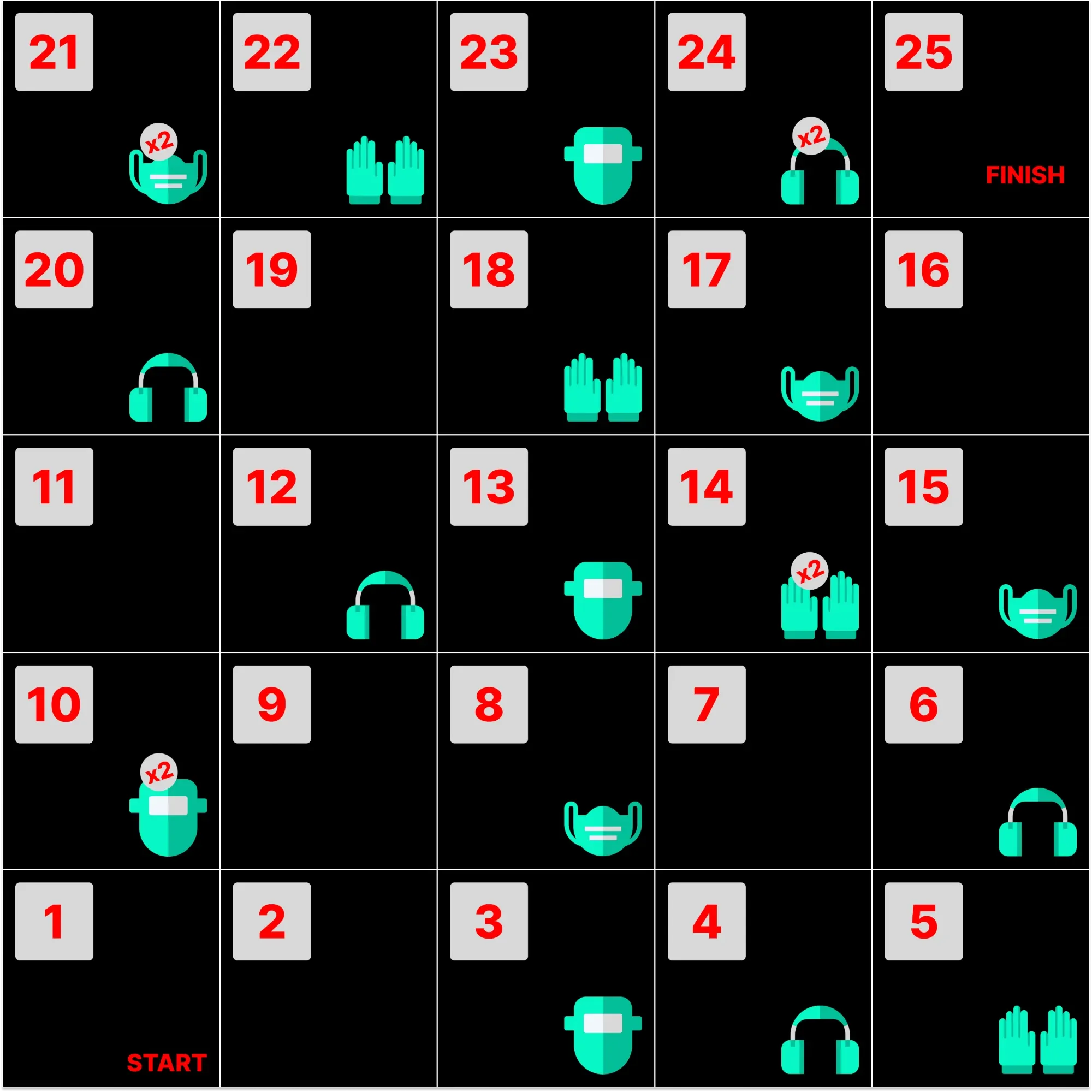
The board. The digital board and the four PPE icons are my work.
How the game works
The user flow
- 1
Welders split into small teams and play together.
- 2
Everyone starts wearing four props: blurred glasses, ear muffs, a mask and a rash sleeve. Each simulates damage to vision, hearing, lungs or skin.
- 3
Teams roll a die and move along the board.
- 4
Landing on a PPE square lets the team take off the matching prop, so the benefit of the gear is felt straight away.
- 5
The first team to land exactly on square 25 finishes the game. Roll too high and you stay put until you roll the number you need.
- 6
A facilitator guides a discussion after the game.
On the board
One icon, one symptom, one prop
Each icon matches one prop, one to one, so there is nothing to memorise. The helmet takes off the glasses, the headphones the ear muffs, the mask the mask, the gloves the rash sleeve.
Blurred glasses
Vision damage
Ear muffs
Hearing loss
Mask
Lung problems
Rash sleeve
Skin irritation


x2 squares let 2 teammates take that prop off at once. We added them after our first tests, when players finished with too many props still on.
We ran the game in reverse on purpose: comfort only comes from choosing safe behaviour, so the reward is relief. Nobody wins alone.
Why it works
Three principles behind the design
Cooperative
Decisions and outcomes are shared, which reinforces teamwork and collective safety.
Immediate feedback
Comfort or discomfort right away builds awareness and safer habits.
Learning by doing
People learn through active participation and their own experience, then reflection, then a change in behaviour.
The look
Our colour palette was taken from the welders' own sites.
Fume black
#000000
Fumes and smoke
Warning red
#FF0000
Danger and hazards
Steel grey
#D9D9D9
The welding environment
Safety green
#08F7C6
Safety
Black and red are pure values on purpose: they match the high-contrast safety signage welders already see on site, and they stay readable on a printed mat under workshop light.
Building it
From whiteboard to full size
How the game went from a sketch to something welders could play, in four steps.
01 · Whiteboard first
We started on a whiteboard
We mapped the rules and player moves on a whiteboard, then tested a low-fidelity digital board in teams. Players still finished with too many props, so we added multiplier squares: two players remove props at once.
02 · Advice and organising
Advice from an expert
A certified LEGO Serious Play facilitator who also works in gamification advised us to ground the game in learning theory, choose a name and brand, and test with the target group. With tasks piling up, I suggested splitting the team into research, design and prototyping groups.
03 · Full size
I led the prototyping
The props and the floor board are the physical interface, so we prototyped them in real materials and kept changing them until they behaved as intended. The mask took two tries. The physical board uses interlocking play mats, so it can be laid out in different sizes on site.
04 · The film
A story about one moment of neglect
We wrote and shot a multilingual awareness film about a welder and his family, showing how one moment of neglect can affect life beyond the workshop. Music, colour, pacing and silence kept it grounded.
Best with sound on. This is the English version. The film was also dubbed in Telugu, Arabic, Bengali, Malayalam, Tamil and Hindi: the language groups most of the welders belong to, and Arabic because the project is based in the UAE.
Testing
Usability testing with ten welders
A live session on site, with the full-size board and props.
10
welders played
~10
minutes of play
7 / 10
said the props mirrored symptoms they'd begun to feel, and that they'd pay more attention to their PPE
What we saw
Where they hesitated, and how fast they learned the game
First reaction and learning the rules
They hesitated to wear the props at first, especially the blurred glasses and the mask. After we explained the long-term effects of welding (eye damage, breathing difficulty, hearing loss and skin disorders) they became more open and put them on. After one roll of the die they understood the flow and joined in comfortably.
After the game
They said the rash sleeve and blurred glasses mimicked, in a small way, what they had begun feeling on the job. That was the shift the brief asked for: from knowing the risk to recognising it in their own body.
3M's view
The 3M team found the game immersive and a practical way to get welders involved and show them what skipping PPE costs.
What broke
Four friction points and the proposed fixes
- Friction point
Stickers started to peel
FixUse professionally printed matte or laminated stickers.
- Friction point
Accessibility: The glasses didn't work for welders who already wear prescription glasses
FixUse clip-on lenses that fit over their own glasses.
- Friction point
The mats didn't join properly because of inaccurate cuts
FixUse custom-cut foam or a single foldable board.
- Friction point
The game ended abruptly
FixAdd a short closing round where teams reflect before the session ends.
Reflection
What I learned
Serious topics can still be engaging
Safety does not have to feel like a lecture. Play gave people a way to participate, make choices and understand consequences without losing the seriousness of the subject.
The rules matter more than the board
Playtesting showed us that the experience could look finished and still not work. Small changes to the mechanics, like introducing multiplier squares, had a bigger impact on the flow than visual polish ever could.
Communication has to work beyond language
Designing for a diverse workforce made us think beyond written instructions. Visual cues, simple interactions and multilingual storytelling helped make the message easier to understand and remember.
What I'd do differently
Test with welders much earlier
I would bring actual workers into the process before the mechanics were fully formed, to understand which situations, behaviours and consequences feel most true to their everyday experience.
What we'd build and try next
Take Weldo onto the worksite
The next step would be a site-ready version designed for toolbox talks, with modular hazard scenarios, a simple facilitator guide and short before-and-after checks to see whether the experience actually improves safety recall and decision-making.
Play Weldo
Play it yourself
A playable digital prototype of the game, in your browser. Race the bot, or share one screen with up to three friends. Skip PPE and the board blurs, sounds muffle and the edges darken. Land on a PPE square and it clears.
How do you want to play?
How many players?
Pick your welders
Name your welders
Square1
- Blurred glasses: 2 of 2 still on
- Ear muffs: 2 of 2 still on
- Mask: 2 of 2 still on
- Rash sleeve: 2 of 2 still on
Finished
This is only a digital version. The real game shows the real effects of not wearing PPE, and the benefits of wearing it, in a short demonstration.
Weldo · Case Study
↑ Back to top
Next project